the hyper realist and verisimilitude
we're currently covering the hyper realist artists in SOVA and i was doing (actually i'm still doing) the matrix thingy but i'm so amazed that i had the sudden urge to just type some things. after looking through Ron Mueck's work, i can't help but be amazed. if i had the chance to see it in real life, i could probably spend close to 15 mins on one sculpture of this, looking at every singly detail of this sculptures. the same goes for duane hanson's works.
DUANE HANSON
he's a hyper realist sculptor and his works are true to scale, life sized and hauntingly realistic. verisimilitude. seriously. just learnt the process of how he creates his sculpture. (talking about processes, this reminds me of chuck close, maybe one day i'll blog a little about my thoughts on him) i personally think the hyperrealism is really cool. its probably one of the most interesting art movements. this is because the artworks are so real that we can easily relate to it. duane hanson's works emphasizes on the human attitude and relationships, the mundane and banal lifestyles of inconspicuous, ordinary, average people is one of the main themes in this work. the stereotyped and prejudices stored in european (and perhaps chinese or any other race) brains concerning the american lifestyle.
because the works are so real, you can't help but question them at first sight. ms ong asked us (in pairs) to form some questions regarding duane hanson's work, such as tourists II. and then we exchanged with the other pair and answer their questions. one of the question the other pair asked was where are the artworks placed and i guess it was placed in a random place in the museum such that it blends in with the crowd. if i were the artist, i would do that. and indeed, that was what hanson did. the sculptures (seen in tourists II) were just placed in the middle of the gallery. at first glance, i would probably ignore the sculptures because they are simply too realistic. i would be oblivious to them, probably thinking their some viewers in the museum. if i weren't observant enough, i may just pass the sculptures without even knowing about them. but if i'm observant enough, i would realize they aren't moving and will cautiously approach them. upon closer inspection would i then realize they are actually an artwork. then. i'll be amazed. and i'll be shock too. then i'll scrutinize the artwork really carefully because its just simply too realistic.
this would be my reaction.
on a side note, one should bear in mind that his work was created in the 1960s-1990s, so the clothing matches the time period of that era, hence it would really blend in with the surroundings. it would be more obvious that the sculptures are actually sculptures and not real human beings now because the dressing style is different.
this made me think of a few things.
1. the context and the artist
the 1970s-1980s in america was the age of consumerism, greed and excess. the television was popular and the lifestyle of the rich was shown to everyone who owned a television. unrealistic expectations form and the line between 'want' and 'need' blurred. duane hanson brought together and featured everyday commodities emphasizing on the mundane, everyday imagery. the lifestyle of the middle class people were emphasized. furthermore, the pop period was after WW2. majority of the feelings were jaded, solemn due to post war. however the pop movement reflected a more childish, fun and less matured view of the society. there was more freedom, the age of excess and a reaction to abstract expressionism. why would hanson wanna emphasize the daily activities of human? we have become so oblivious to what we're doing that it has just become a daily routine to all of us. seeing an old man on a bench is a common sight, there is nothing special or grand about it. most of us would probably ignore the old man, helpful Samaritans would go up to him and ask if he needs any help. such a scene has lost it's meaning, for most of us, it exists to exist. however, such artwork would probably lose its initial meaning in the modern world. the dressing style of the cleaner and the tourists are obviously different that people would notice that there's something odd about these people and would soon realize the sculptures. would these artworks eventually lose their value in the near future? does this mean that they will just become one of the many artworks in the museum, and that there is no longer this essence of surprise?

old man on a bench
2. the artist and the artwork.
how did duane hanson choose his subjects? is it picked randomly? or is there some sort of specific target group? majority of hanson's works showcase stereotyped people, for example american tourists, museum guard, cleaner. they all have a stereotype. (pls bear in mind we're talking about the 1960s to 1990s.) the typical american tourists would be dressed casually, with a camera hung from their necks, maybe a little overweight. a museum guard would be dressed in a dark blue uniform, probably with a hat, sitting or standing in a corner. a typical cleaner would be in a blue or green uniform, pushing the cleaner's truck or whatever you call that. ordinary people are being stereotyped. is an artist also stereotyped? what's the typical impression of an artist? i've never really thought about it. actually i didn't really make the connection that such people are stereotyped. its just in your brain already. you unconsciously stereotyped them. it may be a good thing because such people are unique and they have a certain characteristic or air that is special and unique to them. however, it may be bad because we are generalizing things way too easily and uniqueness and individuality can be lost through such generalization. it is only when told that these people are stereotyped that you actually start thinking about them. and then you realize your impression of them are already given. there are certain criteria and tags that are associated with them. it's only then that you realize that they are being stereotyped. does this mean that hanson also stereotypes these people? how did he feel while creating these work?

tourists II
3. the artwork and the viewers
like mention above, my initial impression of the works and final impression are different. first it was assumed that the works are real people however after realizing that it's an artwork, my attitude towards the work changes drastically. so what's the difference between and human being and a non living thing. why, as a human being, have we so much more interest in a non living thing than a living being? and why do our impression and reaction change so much? why do we care more for a non living thing that our fellow counterparts? why are we so amazed at this work when we see such a scene everyday? we see shoppers, tourists, cleaners but are oblivious to them but when we see it in a gallery we get all worked up. has it got to do with the place where they are found? if an object is placed in a gallery, is it's worth increased? is so why? okay gonna digress a little, if something is placed in a museum, it becomes an artwork. what if it's placed at home, will it's value decrease? why so? is a museum all that powerful? why why why?? i don't get the point. for example, if duchamp's work was placed at some random place, its called junk. if it's placed in the museum, its called art. so what is art? must art only be art when it's in a museum? or is art already everyday but have yet to be discovered/made? if art is defined as a way of expressing oneself then everything would be art. daily conversations would be art as well. but why do some art go unnoticed while some are held so highly and of great importance?whats the difference? would art then disappear one day since its a routine thing and everything thats routine would somehow soon become oblivious to us. so would art end? and the cycle repeats, art will then start of as a method of recording things again? or would it be a reaction to photography or any machine/technology things? since traditional art uses skill and effort while modern art can be ready mades or just making use of technology. would traditional art disappear? techniques from neo classicism and romanticism would disappear? would anyone attempt them again if the emphasis is on modern art, art that is thought provoking, abstract and new, and not just a picture or painting or record of things?
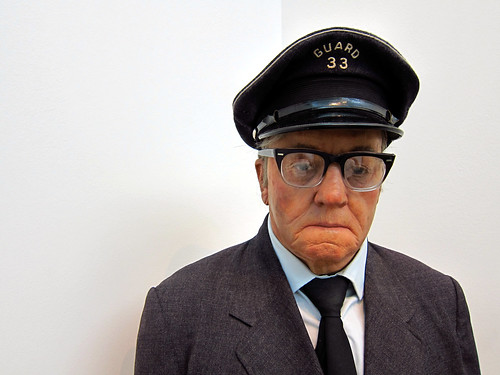
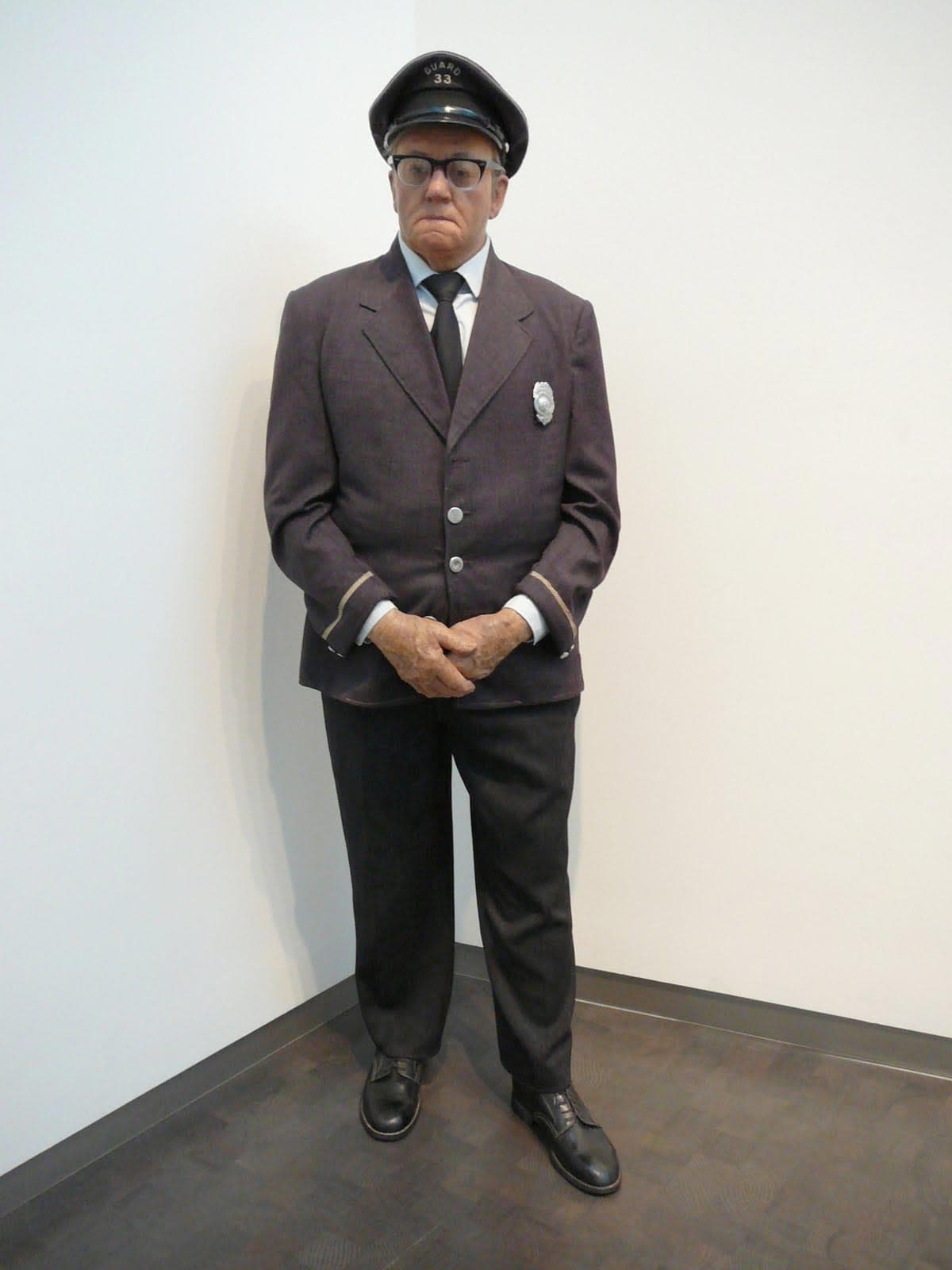
museum guard
4. viewers and viewers, the human condition
why are we more interested in non living beings as compared to our fellow human beings? we encounter so many human beings everyday but we're not as interested in them as compared to the art work. why when we see a realistic sculpture we get amazed and would spend time looking at the work, observing every detail. do we expect these detail or would it come as something new and interesting to us? why are we/should we be amazed at such things? these are common things that we see everyday. we notice every strand of hair on the sculptures and go 'woooooooow'. but look at yourself, and you go 'meh'. what's the difference? isn't a living being more interesting than a non living being since they can talk, they have thoughts, they can question and react while a non living being can do nothing? why do we only pay attention to artworks in a museum and ignore every other person that's in the same museum as you? is it time for us to slow down our pace, maybe time should stop for a while. would it help? if we had the day off to observe anything you want (i think one day would not be enough for me though) would we still be amazed at these artworks? or will they appear normal and uninteresting/less interesting to us? we interact with the artworks more than we interact with one another and that's weird. even though we are humans, why are we still figuring out the human condition? why is the human condition so complex? why do we think so much? why do we question? would there be lesser misunderstandings if we can't question/lose the ability to question? why are we so interested in these sculptures but would rather spend our time with real human beings? i would like to know when seeing these sculptures, what goes though your minds? when viewing these sculptures, we probably would be so amazed and would look at every detail but when put in a room with the sculptures, we may be afraid of them as they are very real. why so? why the sudden change in attitude due to the change in environment? also, we can get bored of these sculptures after a while but why do we not get bored with our best friend? our spouse? our partners? isit because of their ability to speak? what is it that attracts us to these works?

queenie
okay these are just thoughts and i just wrote it in the stream of consciousness way. theres a lot a lot of questions, dramatically incorrect. these are raw thoughts heh. will do one on ron mueck soon!


